A practical guide to licences, tax, safety, compliance, insurance, and getting your first jobs
How to start a tradie business? Starting your own trade business is one of the most common paths tradies take once they have experience under their belt. The appeal is obvious. More control over your work, the ability to choose your jobs, and the chance to build something that goes beyond hourly wages.
But this is also where many tradies get caught out.
Being good at your trade is only part of the equation. Running a trade business in Australia means dealing with licences, tax, insurance, safety obligations, and legal responsibilities that do not exist when you are on wages. Miss one of these and the consequences can range from lost work and unpaid claims to fines, licence issues, or personal liability.
This guide exists to close that gap.
It is written specifically for Australian tradies who are thinking about starting their own business, or who have already started and want to make sure they have set things up properly. It walks through the full picture, from choosing the right business structure and registering correctly, through to understanding what you are legally allowed to do, meeting safety and WHS requirements, and winning your first jobs.
You do not need to do everything perfectly on day one. But you do need to understand the rules you are operating under. The tradies who last are the ones who get the fundamentals right early and build from there.
This article is designed as a practical reference you can come back to as your business grows. Where requirements differ by state, we will point that out and link to more detailed state-based guides so you can check the rules that apply to you. You can also bookmark 101 free tools for tradies as you will need that once you begin.
When the foundations are right, everything else becomes easier.
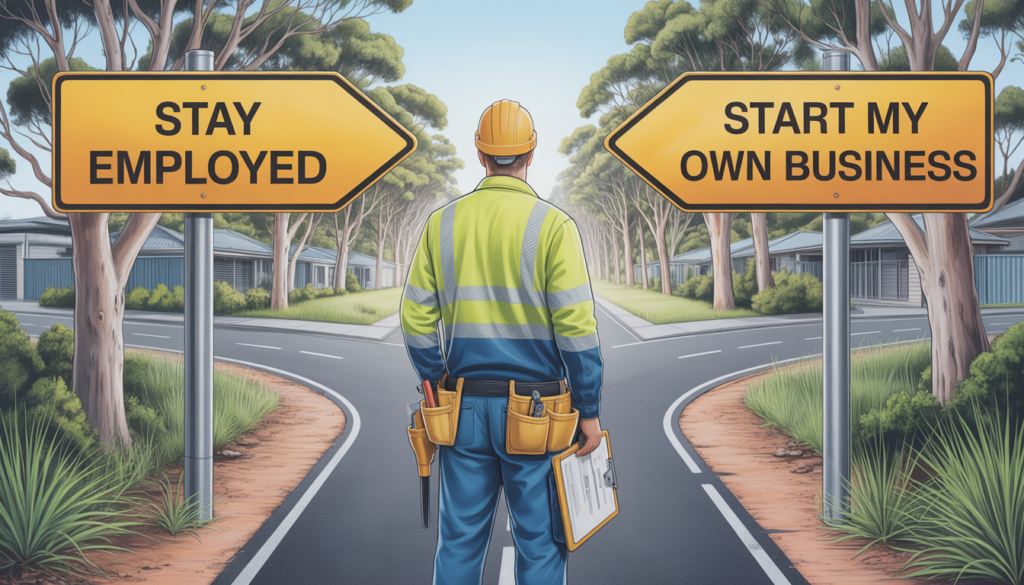
Is Starting Your Own Trade Business Right for You?
Before registering an ABN or buying a new ute, it is worth taking an honest look at what running your own trade business actually involves.
When you go out on your own, your role changes. You are no longer just a tradie. You also become the person responsible for quoting, invoicing, compliance, safety, tax, and client relationships. The work does not stop when you leave site.
For many tradies, this is a positive shift. It allows you to choose your jobs, build direct relationships with clients, and create income that is not capped by hourly rates. For others, especially those who prefer to just turn up and work, it can feel overwhelming if expectations are not clear from the start.
You may be ready to start your own business if:
- You are fully qualified or appropriately licensed in your trade
- You understand the type of work you are legally allowed to perform
- You are comfortable taking responsibility for safety and compliance
- You can manage basic admin or are willing to get help
- You want long-term control rather than short-term convenience
You may need more preparation if:
- You are unsure about licensing or trade scope
- You rely heavily on others to organise work and paperwork
- You do not yet have consistent site experience
- You are not prepared for irregular cashflow early on
There is no right or wrong answer. Some tradies move straight into business and thrive. Others spend time building experience, savings, and systems before making the jump.
What matters most is understanding that starting a trade business is not just a change in who you work for. It is a change in responsibility. If you are clear on that from the outset, the next steps become far more manageable.
Choosing the Right Business Structure (Sole Trader vs Company)
One of the first and most important decisions you will make is how to structure your trade business. This choice affects your tax, your personal risk, how clients see you, and how easy it is to grow later.
There is no single “best” option for all tradies. The right structure depends on the type of work you do, the level of risk involved, and where you want the business to go.
Sole Trader – What It Means for Tradies
Operating as a sole trader is the most common starting point for new trade businesses in Australia.
As a sole trader, the business and the individual are legally the same. You trade under your own name or a registered business name, and all income is taxed as personal income.
This structure works well if you are:
- Just starting out
- Doing mainly residential work
- Keeping overheads low
- Working alone or with occasional subcontractors
The main advantages are simplicity and cost. Setup is quick, accounting is simpler, and ongoing compliance requirements are lower than a company structure.
The main downside is risk. If something goes wrong, such as a serious insurance claim, dispute, or debt, your personal assets can be exposed. This is why higher-risk trades often move away from sole trader structures earlier.
Company (Pty Ltd) – When It Makes Sense
A proprietary limited company is a separate legal entity from you as an individual. The company earns the income, holds contracts, and carries most of the risk.
This structure is commonly used by tradies who:
- Work on commercial or high-risk sites
- Employ staff or apprentices
- Want to grow beyond one person
- Deal with councils, builders, or large organisations
A company structure can offer better asset protection and often appears more professional to commercial clients. It also gives you more flexibility in how you pay yourself, with wages and dividends handled separately.
The trade-off is increased complexity. Companies cost more to set up, require separate tax returns, stricter record keeping, and come with director responsibilities that cannot be ignored.
Key Differences That Affect Risk, Tax, and Growth – How to Start a Tradie Business
The biggest difference between a sole trader and a company is not tax rates. It is risk and scalability.
Sole traders are simpler but personally exposed. Companies are more complex but better suited to long-term growth and larger contracts.
Many tradies start as sole traders and later transition to a company once their workload, risk profile, or client base increases. What matters most is choosing a structure that matches where you are now, while keeping future growth in mind.
ABN, Business Name, TFN, and GST Explained Simply
Once you have decided on your business structure, the next step is getting the basics registered correctly. This is where many tradies rush and make avoidable mistakes that later cause tax or compliance issues.
Getting this right early makes everything else smoother, from invoicing clients to dealing with the tax office.
ABN and Business Name Registration
Every trade business in Australia needs an Australian Business Number (ABN). Without one, you cannot legally invoice for work.
Your ABN is issued through the Australian Business Register and is used by clients, suppliers, and the tax office to identify your business.
If you trade under your own personal name as a sole trader, you do not need a separate business name. However, if you want to operate under a name like “Smith Electrical Services” or “Coastal Plumbing Co”, you must register that business name with ASIC.
For companies, the company name itself is registered with ASIC, and you may still register a separate trading name if required.
Business name registration does not give you legal protection or exclusivity by itself. It simply allows you to trade under that name.
TFN and Business Banking
Sole traders use their personal Tax File Number (TFN). Companies receive a separate TFN once registered.
Regardless of structure, you should open a separate business bank account. Mixing personal and business finances is one of the fastest ways to create accounting problems and attract unwanted attention from the Australian Taxation Office.
Keeping finances separate also makes it far easier to track expenses, manage tax obligations, and understand whether your business is actually profitable.
GST – When You Must Register (and When It Helps)
You are legally required to register for GST once your business turnover reaches, or is expected to reach, $75,000 per year.
Many tradies choose to register earlier, even if they are below this threshold. This can make sense because:
- You can claim GST credits on tools, vehicles, fuel, and materials
- Commercial clients often expect GST registration
- It can make your business appear more established
The downside is additional admin. You must lodge Business Activity Statements (BAS) and ensure GST collected from clients is set aside rather than spent.
A common mistake is treating GST money as income. GST is not your money. It belongs to the tax office and should be managed accordingly.
Common Tax Mistakes New Tradies Make
Some of the most common issues seen with new trade businesses include:
- Not registering for GST on time
- Failing to set money aside for tax
- Claiming personal expenses as business deductions
- Poor record keeping or missing receipts
- Ignoring BAS obligations until penalties apply
These issues rarely happen due to dishonesty. They happen because many tradies were never taught how the business side works.
Getting basic accounting advice early is one of the best investments you can make.
Licences, Trade Qualifications, and Tickets (What You Can and Cannot Do)
Your licence and qualifications define what work you are legally allowed to perform. This is one of the most important areas to get right, because working outside your scope can void insurance, attract fines, and stop you from winning commercial work.
Many tradies assume experience alone is enough. Legally, it is not.
Licensed Trades vs Unlicensed Work
In Australia, many trades are licensed or regulated, including but not limited to:
- Electrical
- Plumbing and drainage
- Building and construction
- Refrigeration and air conditioning
- Fire protection services
- Gas fitting
If your trade requires a licence, you must:
- Hold the correct licence class
- Perform only the work covered by that licence
- Comply with any supervision or endorsement conditions
You cannot legally perform restricted work simply because you “know how” or have done it before under someone else. Licensing is about legal authority, not skill alone.
Trade Qualifications and Experience
Formal qualifications and on-the-job experience are both important, but they serve different purposes.
Qualifications:
- Prove you have met required training standards
- Are often mandatory for licensing
- Are checked by regulators and insurers
Experience:
- Determines the quality and efficiency of your work
- Affects your ability to price and manage jobs
- Is often assessed by builders and clients
Having one without the other creates risk. For example, holding a qualification without enough site experience can lead to safety issues. Having experience without the right licence can lead to legal and insurance problems.
Common Tickets Required on Sites
Beyond your core trade licence, many sites require additional tickets before you are allowed to start work. These vary depending on the type of work and site but commonly include:
- White Card (mandatory on construction sites)
- Working at Heights
- Confined Spaces
- Elevated Work Platform (EWP)
- Asbestos Awareness
- First Aid
- High Risk Work Licences (forklift, dogging, rigging)
Commercial, government, and large builder sites will often request evidence upfront. If you cannot provide it, you may not be allowed onsite, even if you are fully licensed in your trade.
Working Outside Your Licence (Why It Is Dangerous)
Working outside your licence scope is one of the fastest ways to:
- Void your insurance
- Breach WHS laws
- Lose builder or client trust
- Face regulatory action
Examples include:
- Performing electrical or plumbing work without the correct licence
- Signing off on work you did not supervise
- Allowing unlicensed workers to carry out restricted tasks
- Taking on work that exceeds your licence class
These issues often surface after something goes wrong, such as an injury, defect, or dispute. By then, the damage is already done.
Understanding exactly what your licence allows, and where the limits are, protects both your business and your future ability to work.
What Tradies Are Legally Allowed to Do (And What They Are Not)
One of the biggest risks for new trade businesses is not knowing where the legal boundaries are. Many tradies do the wrong thing without realising it, simply because “that’s how it’s always been done”.
Understanding what you can and cannot do protects your licence, your insurance, and your ability to keep working.
Sole Traders – Legal Limits You Need to Understand
As a sole trader, you are legally responsible for everything the business does.
You are allowed to:
- Perform work within your licence and trade scope
- Quote, invoice, and contract directly with clients
- Engage subcontractors for specialist or overflow work
- Claim legitimate business deductions
- Register for GST and employ staff if required
You are not allowed to:
- Operate outside your licence or trade scope
- Ignore safety and WHS duties
- Avoid tax, GST, or superannuation obligations
- Treat workers as subcontractors if they are actually employees
- Assume personal assets are protected if something goes wrong
If there is a serious incident or legal claim, responsibility sits with you personally.
Companies and Directors – Responsibilities Still Apply
Running your trade business through a company does not remove accountability.
A company can:
- Enter contracts and hold work
- Employ staff and apprentices
- Limit personal liability in many cases
- Appear more credible for commercial work
However, directors cannot:
- Ignore WHS duties
- Trade while insolvent
- Avoid tax or super obligations
- Use the company to shield reckless or illegal behaviour
Regulators can and do pursue directors personally where obligations are breached.
Subcontractors vs Employees (Sham Contracting Risks)
This is one of the most misunderstood areas in the trade industry.
Subcontractors are allowed to:
- Work for multiple clients
- Control how they perform their work
- Supply their own tools and equipment
- Invoice for completed work
- Carry their own insurances
They are not allowed to be:
- Treated like employees in practice
- Paid hourly with no independence
- Forced to work fixed hours only for one business
- Supplied with all tools, vehicles, and uniforms
Incorrectly classifying workers can trigger investigations by the Fair Work Ombudsman and result in back payments, penalties, and compliance action.
Advertising, Quoting, and Representations
Tradies are legally responsible for how they represent their business.
You are allowed to:
- Advertise services you are licensed to provide
- Promote your experience truthfully
- Quote work within your legal scope
- Use your correct trade title
You are not allowed to:
- Claim licences you do not hold
- Advertise services outside your scope
- Use protected titles incorrectly
- Mislead clients about qualifications or experience
Misrepresentation can void contracts and insurance and expose you to claims.
Safety Responsibilities Under WHS Laws
Safety is not optional, even if you work alone.
Under Australian WHS laws, tradies are considered duty holders. This means you are responsible for:
- Identifying hazards in your work
- Managing risks through safe systems
- Providing and using appropriate PPE
- Following site safety rules
- Reporting incidents and near misses
This applies whether you are a sole trader, subcontractor, or company director.
Regulators such as Safe Work Australia make it clear that “not knowing” is not a defence.
Knowing where the legal lines are drawn helps you make better decisions on jobs, pricing, and growth. It also makes your business far more attractive to builders, facility managers, and commercial clients.
Insurance Every Trade Business Must Have
Insurance is one of the most important protections you can put in place when starting your own trade business. It is also one of the fastest ways a business can fail if it is misunderstood or set up incorrectly.
Many tradies only discover gaps in their cover after something goes wrong.
Public Liability Insurance
Public liability insurance covers injury to other people or damage to property caused by your work.
This is essential for all trade businesses, regardless of size. Most builders, strata managers, councils, and commercial clients will require proof of cover before you are allowed onsite. Common minimum requirements range from $10 million to $20 million.
Public liability insurance generally covers:
- Accidental damage to client property
- Injury to third parties caused by your work
- Legal defence costs related to claims
It does not cover:
- Defective or non-compliant work
- Work performed outside your licence scope
- Incidents caused by gross negligence
Workers Compensation Insurance
If you employ staff, apprentices, or in some cases engage subcontractors, workers compensation insurance is mandatory.
Workers compensation covers:
- Medical costs for injured workers
- Lost wages
- Rehabilitation expenses
Each state has its own workers compensation scheme, and requirements can differ. Failing to hold the correct cover can result in significant penalties and personal liability.
Even sole traders should check whether specific sites or contracts require evidence of workers compensation cover before work can commence.
Professional Indemnity Insurance (When Required)
Professional indemnity insurance is required if your trade involves:
- Design or advisory services
- Certification or sign-off responsibilities
- Technical recommendations relied on by others
Examples include fire services, building consultants, and trades that provide compliance documentation.
This insurance covers claims arising from:
- Errors or omissions
- Incorrect advice
- Design or specification issues
Without it, even a small mistake can become a major financial issue.
Tools, Equipment, and Vehicle Insurance
Your tools and vehicle are critical business assets.
While not always legally required, insurance for tools, equipment, and vehicles protects you against:
- Theft
- Damage
- Downtime that stops you working
Tool theft is one of the most common claims in the trade industry and can quickly derail a new business if not covered.
When Insurance Will NOT Pay Out
This is where many tradies get caught out.
Insurance providers may refuse to pay claims if:
- The work was unlicensed or outside declared trade scope
- Required safety systems were not in place
- SWMS or risk assessments were missing
- Licences or tickets were not current
- Activities were not disclosed to the insurer
Insurance relies heavily on compliance. Having cover on paper is not enough if the conditions of that cover are not met in practice.
Insurance should be reviewed whenever your business changes, such as taking on new types of work, hiring staff, or moving into commercial projects. What covered you at the start may not be sufficient as you grow.
Tools, Equipment, and Vehicles (Business Setup Reality)
Tools and vehicles are often the biggest upfront cost when starting a trade business. They are also where many tradies overspend early, putting unnecessary pressure on cashflow.
The goal at the start is not to have the best setup. It is to have a functional, compliant, and reliable setup that allows you to work safely and professionally.
Tools You Need vs Tools You Want
Every trade has a core set of tools that are essential to operate safely and effectively. These should be prioritised first.
Essential tools are those that:
- Are required to perform your licensed work
- Are needed to meet safety requirements
- Allow you to complete jobs without relying on others
Non-essential tools often include:
- Specialised tools used only occasionally
- Premium versions of tools you already own
- Equipment that can be hired when needed
Starting lean reduces financial stress and allows you to reinvest once income becomes consistent.
Buying vs Financing Equipment
For larger or more expensive equipment, you generally have three options:
- Buy outright
- Finance through a loan
- Lease or hire
Buying outright reduces ongoing costs but ties up cash. Financing or leasing spreads costs but increases monthly commitments. Hiring can be a smart option for specialised or infrequently used equipment.
From a tax perspective, tools and equipment used for business purposes may be deductible or depreciated over time. The best approach depends on your cashflow and business structure, so professional advice is worthwhile here.
Vehicle Choices and Practical Considerations
Your vehicle is more than transport. For most tradies, it is a mobile workshop.
Common options include:
- Utes with toolboxes
- Vans with internal storage systems
- Trailer setups for larger equipment
When choosing a vehicle, consider:
- Payload and towing capacity
- Fuel costs
- Maintenance and reliability
- Security for tools
- Ease of access on sites
A vehicle that is unreliable or poorly set up can cost far more in lost time than it saves upfront.
Vehicle Expenses and Tax Considerations
Business vehicles can attract significant deductions, but only if managed correctly.
Depending on your setup, you may be able to claim:
- Fuel and servicing
- Insurance and registration
- Depreciation or finance costs
However, personal use must be accounted for, and record keeping is essential. Incorrect claims are a common issue flagged by the Australian Taxation Office.
Separating personal and business use as much as possible makes compliance easier and reduces risk.
A practical tools and vehicle setup supports productivity, safety, and professionalism. It also sends a clear signal to clients and builders that you take your business seriously.
Safety, WHS, and Compliance (Why This Decides Who Gets Work)
Safety and WHS compliance is no longer just a box to tick. For many builders, facility managers, and commercial clients, it is one of the first things they assess before engaging a tradie.
This is where the gap between residential-only work and consistent commercial work becomes very clear.
WHS Duties for Tradies (Even Sole Traders)
Under Australian WHS laws, tradies are considered duty holders. This applies whether you are:
- A sole trader
- A subcontractor
- A company director
- Working alone or on a large site
You are legally required to:
- Identify hazards related to your work
- Assess and control risks
- Work in a way that does not put others at risk
- Follow site safety rules and procedures
- Use appropriate personal protective equipment (PPE)
The misconception that “safety is the builder’s responsibility” is one of the most common and costly mistakes tradies make.
SWMS, Risk Assessments, and Site Requirements
Many sites now require documented safety systems before work can begin.
These commonly include:
- Safe Work Method Statements (SWMS)
- Task-based risk assessments
- Induction records
- Training and competency evidence
- Incident and hazard reporting processes
For high-risk construction work, SWMS are not optional. They are a legal requirement and are often requested before a quote is even accepted.
If you cannot supply these documents when asked, you may:
- Lose the job
- Be removed from site
- Be excluded from future work
- Breach contractual obligations
Residential vs Commercial Safety Expectations
Residential clients may not ask for formal safety documentation, but that does not remove your legal obligations.
Commercial, government, and institutional clients almost always require:
- Written WHS systems
- Proof of compliance
- Ongoing safety reporting
The difference is not the law. It is the level of enforcement.
Tradies who prepare for commercial standards early find it much easier to transition into higher-quality, more consistent work.
Why Builders and Clients Reject Non-Compliant Tradies
From a client’s perspective, engaging a non-compliant tradie creates risk.
If a tradie:
- Cannot produce safety documents
- Has no incident reporting process
- Cannot demonstrate compliance
- Has unclear responsibilities
The risk is pushed onto the builder or client.
As a result, many will choose a compliant tradie at a higher price over a cheaper one who creates uncertainty. Compliance is no longer just about avoiding penalties. It is a competitive advantage.
Compliance Is a Business System, Not Paperwork
The most successful trade businesses treat safety and compliance as part of how the business operates, not as paperwork done under pressure.
When systems are in place:
- Quoting becomes easier
- Site access is faster
- Trust with clients increases
- Risk is reduced across the business
This is also where structured platforms and systems can save significant time compared to managing documents manually.
Pricing Jobs Properly (So You Don’t Burn Out)
One of the fastest ways a trade business fails is not through lack of work, but through poor pricing. Many tradies stay busy yet struggle financially because their pricing does not reflect the true cost of running a business.
Getting pricing right early is critical for sustainability.
What Your Pricing Must Include
Your hourly rate or job price needs to cover far more than just the time spent on the tools.
At a minimum, pricing should account for:
- Labour time on site
- Travel time
- Materials and consumables
- Insurance costs
- Tools and equipment wear
- Vehicle expenses
- Safety and compliance costs
- Tax and super obligations
- Non-billable admin time
- A profit margin
If any of these are missing, the business is subsidising the job rather than being paid properly for it.
Why Underquoting Kills Trade Businesses
Underquoting often happens because tradies compare themselves to employees, not businesses.
When you are on wages, your employer covers:
- Insurance
- Vehicles
- Tools
- Safety systems
- Admin staff
- Downtime
When you run a business, you cover all of this yourself.
Consistently underquoting leads to:
- Long hours with little reward
- Cashflow stress
- Deferred maintenance on tools and vehicles
- Skipping safety or compliance steps
- Burnout
Being cheaper is not a long-term strategy.
Residential vs Commercial Pricing Reality
Residential work is often price-driven and competitive. Commercial work is more compliance-driven and reliability-focused.
Commercial clients typically care about:
- Safety compliance
- Reliability
- Documentation
- Clear communication
- Consistency
They are often prepared to pay more for certainty.
Tradies who price with compliance and systems in mind are better positioned to move into higher-quality commercial work rather than chasing volume in residential markets.
Pricing for Growth, Not Just Survival
Your pricing should allow you to:
- Replace tools and vehicles when needed
- Take time off without financial stress
- Invest in better systems
- Grow beyond one person if desired
If your pricing only covers today’s costs, the business has no buffer for tomorrow.
Pricing properly is not about charging the most. It is about charging enough to operate safely, compliantly, and sustainably.
Getting Your First Jobs as a New Trade Business
Getting your first steady stream of work is often the most stressful part of starting a trade business. The good news is that most tradies already have more opportunity than they realise. The challenge is positioning yourself correctly so people are comfortable engaging you.
Early jobs are not just about income. They set your reputation.
Start With Existing Networks
Your first work usually comes from people who already know you.
This can include:
- Former employers (where allowed)
- Builders you have worked with previously
- Other tradies who need overflow support
- Friends, family, and referrals
Let people know clearly:
- You are now operating your own business
- What work you do and do not take on
- Where you are willing to travel
- How to contact you professionally
Many tradies miss work simply because people do not realise they are available.
Builders, Facilities, and Commercial Opportunities
Builders, facility managers, and maintenance providers are often looking for reliable tradies, not just the cheapest.
To work with these clients, you will usually need:
- Valid licences and insurances
- Safety documentation
- Professional invoicing
- Clear communication
- Consistent availability
This is where many new businesses stall. Not because they lack skill, but because they cannot meet compliance or admin expectations.
Once you are approved with a builder or facility manager, work can become far more consistent than one-off residential jobs.
Online Presence and Professional Signals
You do not need a complex website to start, but you do need to look legitimate.
At a minimum:
- A registered business name
- Professional invoices
- Clear contact details
- Consistent branding
- Prompt communication
These signals reduce perceived risk for clients and make it easier for them to say yes. Online presence can also mean using job sites to find work.
Why Compliance Wins Jobs (Even Over Cheaper Quotes)
From a client’s perspective, engaging a tradie is about risk management.
A tradie who can:
- Provide licences and insurances quickly
- Supply safety documents when requested
- Communicate clearly
- Follow site rules
Is often chosen over someone cheaper who creates uncertainty.
Compliance does not just protect you. It actively helps you win work.
Build Relationships, Not Just Quotes
Early success often comes from being reliable rather than trying to scale too fast.
Turning up when you say you will, communicating delays early, and finishing jobs properly builds trust. That trust leads to repeat work and referrals, which is the most sustainable form of growth for a trade business.
State-Based Rules for Tradies (Important Differences Across Australia)
While the fundamentals of running a trade business are similar across Australia, licensing, registration, and compliance rules are set at a state and territory level. This means what is allowed in one state may not be allowed in another, even for the same trade.
It is critical to check the rules that apply where the work is performed, not just where your business is registered.
Below is a high-level overview. Each section should link to a dedicated state guide with detailed requirements.
New South Wales (NSW)
NSW has some of the most structured licensing and compliance frameworks in the country.
Key points for tradies in NSW:
- Many trades require specific licence classes
- Contractor licences are common for higher-value work
- Strong enforcement around defective work and consumer protection
- Safety documentation is often required for commercial sites
👉 Link to: Tradie licensing and compliance in NSW
Queensland (QLD)
Queensland places strong emphasis on licensing, especially in construction and electrical trades.
Key points for tradies in QLD:
- Trade contractor licences are common
- Licensing requirements are tightly enforced
- Some work types require both individual and business-level registration
- Safety compliance is heavily scrutinised on commercial sites
👉 Link to: Tradie licensing and compliance in QLD
Victoria (VIC)
Victoria has specific registration bodies for many trades and a strong focus on consumer protections.
Key points for tradies in VIC:
- Registration and licensing vary by trade
- Domestic building work has strict requirements
- Clear separation between registered practitioners and unlicensed workers
- Strong oversight of safety practices on construction sites
👉 Link to: Tradie licensing and compliance in VIC
Western Australia (WA)
WA has its own licensing systems and regulatory bodies, particularly for electrical and building trades.
Key points for tradies in WA:
- Licensing requirements differ significantly from eastern states
- Some trades require both personal and business registration
- Remote and regional work can have additional requirements
- Safety enforcement varies by industry and site type
👉 Link to: Tradie licensing and compliance in WA
South Australia (SA), Tasmania (TAS), Northern Territory (NT), and ACT
These jurisdictions have smaller markets but still enforce trade and safety compliance.
General considerations:
- Licensing requirements still apply, even for small jobs
- Mutual recognition may apply, but must be confirmed
- Safety obligations remain the same regardless of state size
- Commercial and government work often follows strict compliance rules
👉 Link to: Tradie licensing and compliance by state and territory
A Note on Working Across State Borders
If you work across multiple states, do not assume your licence automatically applies everywhere. Mutual recognition can help, but it is not automatic and usually requires formal application.
Always confirm:
- Licence recognition status
- Insurance coverage by state
- Local safety and compliance requirements
Getting this wrong can stop work immediately and create serious legal and insurance issues.
When to Scale Up (Staff, Apprentices, Bigger Jobs)
For many tradies, the goal of starting a business is not just to work for themselves, but to build something that can grow. Scaling up can increase income and stability, but it also increases responsibility. Knowing when and how to scale is critical.
Growing too early causes stress. Growing too late can cap your potential.
Hiring Your First Worker
Hiring your first employee or apprentice is a major step.
Before you do, make sure you have:
- Consistent workflow
- Reliable cashflow
- Correct insurances in place
- Time to supervise and train
- Safety systems that scale beyond one person
Employing staff means taking on obligations such as:
- Workers compensation insurance
- Superannuation payments
- PAYG withholding
- Training and supervision duties
Many tradies underestimate the time and cost involved. Hiring should solve a problem, not create one.
Using Subcontractors to Scale Safely
Subcontractors can be a lower-risk way to grow if managed correctly.
They allow you to:
- Take on larger jobs
- Manage peaks in workload
- Access specialist skills
- Reduce fixed employment costs
However, subcontractors must operate independently. Treating them like employees while calling them subcontractors creates legal risk and can trigger investigations.
Clear agreements, proper classification, and compliance checks are essential.
Moving From Sole Trader to Company
As a business grows, many tradies move from sole trader to a company structure.
This often happens when:
- Job values increase
- Risk exposure grows
- Staff are employed
- Commercial clients are engaged
Transitioning structures should be planned carefully. It involves changes to banking, insurance, tax, and contracts. Professional advice is strongly recommended to avoid disruptions.
Systems You Need Before Scaling
Scaling is less about working harder and more about having systems in place.
Before taking on bigger work, consider:
- Documented safety procedures
- Clear quoting and invoicing processes
- Reliable subcontractor management
- Incident reporting systems
- Record keeping and compliance tracking
Businesses that scale without systems often hit a ceiling quickly or fail under pressure.
Bigger Jobs Bring Bigger Responsibility
Larger contracts and commercial work come with higher expectations around safety, compliance, and professionalism.
The tradies who succeed at this level are not just good operators. They are organised, compliant, and proactive in managing risk.
Scaling is not mandatory. Many tradies choose to stay small and profitable. What matters is aligning growth with your capacity and goals.
Final Advice for Tradies Starting Their Own Business
Starting your own trade business in Australia can be one of the best decisions you make, but only if it is approached with the right expectations.
Most problems tradies face are not caused by poor workmanship. They come from gaps in structure, compliance, and understanding what the business is responsible for once you step off wages.
If you take one thing away from this guide, let it be this: your trade skills get you started, but your systems keep you in business.
The tradies who last are the ones who:
- Work within their licence and legal scope
- Set up their business correctly from day one
- Price their work to cover real costs
- Take safety and compliance seriously
- Build trust with clients through professionalism
You do not need to have everything perfect at the start. What matters is knowing what is required, recognising risks early, and putting systems in place as the business grows.
Safety, compliance, and structure are not obstacles. They are what allow you to win better work, reduce stress, and build a business that actually supports your life rather than consuming it.
If you treat your trade like a business from the outset, you give yourself the best possible chance of long-term success.