If you’re a builder in Australia, sooner or later someone will ask:
“What paperwork do you need on site?”
It might be:
- A principal contractor
- A site supervisor
- A council inspector
- WorkSafe
- Or a commercial client doing a spot check
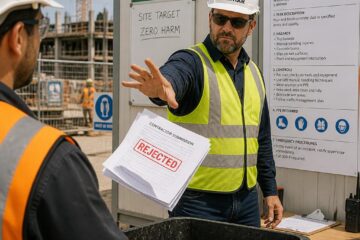
And if you don’t have the right documents ready, jobs can be delayed, inductions rejected, or worse – work stopped. This is why this guide on what documents builders need on site is critical to your success.
This guide breaks down exactly what documents builders are expected to have on site, what’s legally required, what’s commonly requested, and what’s often misunderstood.
No fluff. No overkill. Just what actually matters.
The Short Answer (For Busy Builders)
On most residential and commercial sites, builders are expected to have:
- A WHS / Safety Management Plan
- A Safe Work Method Statement (SWMS) for high-risk work
- Site induction records
- Licences and insurances
- Risk assessments / registers
- Emergency procedures
Not all at once. Not all printed.
But available and up to date.
Let’s break it down properly.

1. WHS Management Plan (Site Safety Plan)
When it’s required
- Legally required for construction projects over $250,000
- Often requested even under $250k, especially on commercial jobs
What it does
This document explains how safety is managed on the site overall, including:
- Roles and responsibilities
- Site rules
- Inductions
- Emergency procedures
- How risks are identified and controlled
- How subcontractors are managed
Common mistake
Builders assume a WHS plan is “head office paperwork”.
In reality:
- Inspectors expect it to be site-specific
- Principal contractors often require it before site access
2. Safe Work Method Statement (SWMS)
This is the big one.
When a SWMS is required
A SWMS is required before any high-risk construction work starts, including:
- Working at heights (over 2m)
- Excavations
- Demolition
- Structural alterations
- Use of certain plant and equipment
- Work near traffic, services, or live electrical systems
Important clarification
You do not need dozens of SWMS.
One well-written, all-in-one SWMS can cover:
- Multiple high-risk tasks
- Multiple stages of work
- Both residential and commercial builds
As long as:
- The hazards are identified
- The controls are clear
- It reflects the work being done on site
What inspectors actually check
They look for:
- A SWMS that makes sense for the job
- Evidence workers know it exists
- Sign-off or induction referencing it
They are not impressed by generic copy-paste templates.
3. Site Induction Records
What’s required
Anyone working on site should:
- Complete a site induction
- Be aware of site rules
- Understand emergency procedures
- Acknowledge relevant SWMS
What builders often forget
- Inductions must be recorded
- Inspectors often ask: “How do you know this worker has been inducted?”
A simple signed induction form or digital record is enough.
4. Licences and Insurances
These don’t always need to be pinned to the wall, but they must be accessible.
Commonly requested documents
- Builder licence (state-specific)
- Public liability insurance
- Workers compensation insurance
- White cards (for workers)
When they’re checked
- Site audits
- Tender requirements
- Incident investigations
- Client compliance checks
If you can’t produce them quickly, it raises red flags.
5. Risk Assessments, Registers & Checklists
These support your SWMS and safety plan.
Common examples:
- Risk register
- Plant and equipment checklists
- PPE register
- Incident and hazard report forms
- Pre-start checklists
Do you need all of them on site?
Not always physically.
But you should be able to show:
- That risks are being identified
- That checks are happening
- That issues are recorded and addressed
This is about evidence, not paperwork overload.
6. Emergency Procedures
Inspectors love asking this question:
“If something goes wrong right now, what happens?”
You should have:
- Emergency contacts
- First aid arrangements
- Evacuation procedure
- Nearest hospital information
It can be:
- Part of your WHS plan
- Displayed on site
- Included in inductions
But it must be known, not just written.
What Builders Often Get Wrong
“It’s a small job, so I don’t need paperwork”
Not true.
High-risk work still requires a SWMS regardless of job size.
“My subcontractor handles their own safety”
As the builder or principal contractor, you still carry responsibility.
“I’ll sort it out if someone asks”
By the time someone asks, it’s often too late.
What Inspectors Actually Care About
This is important.
They care about:
- Is there a safety system?
- Does it reflect the work being done?
- Do workers understand it?
- Is it being followed?
They do not care about:
- Fancy formatting
- Overly long documents
- Perfect wording
Simple, relevant, and used beats complex every time.
How Smart Builders Handle This
Good builders:
- Use one clear SWMS that covers their work
- Keep safety documents ready before site starts
- Use templates they can edit quickly per job
- Avoid free generic templates that don’t match reality
This is where having a builder-specific SWMS template saves time, stress, and arguments on site. Many builders use a ready-made Builder SWMS Template that covers common high-risk work and can be quickly adjusted for each job.
Final Takeaway
If you’re a builder, the documents you need on site are not about bureaucracy.
They’re about:
- Getting approved faster
- Avoiding delays
- Protecting yourself legally
- Keeping work moving
You don’t need everything.
But you do need the right things.
And you need them before someone asks.